Four years ago, Brian, was working as a builder in Cardiff. Life changed in an instant when he fell from a roof, landing on a wall, and ending up in hospital. What began as a routine scan for trauma, led to devastating news.
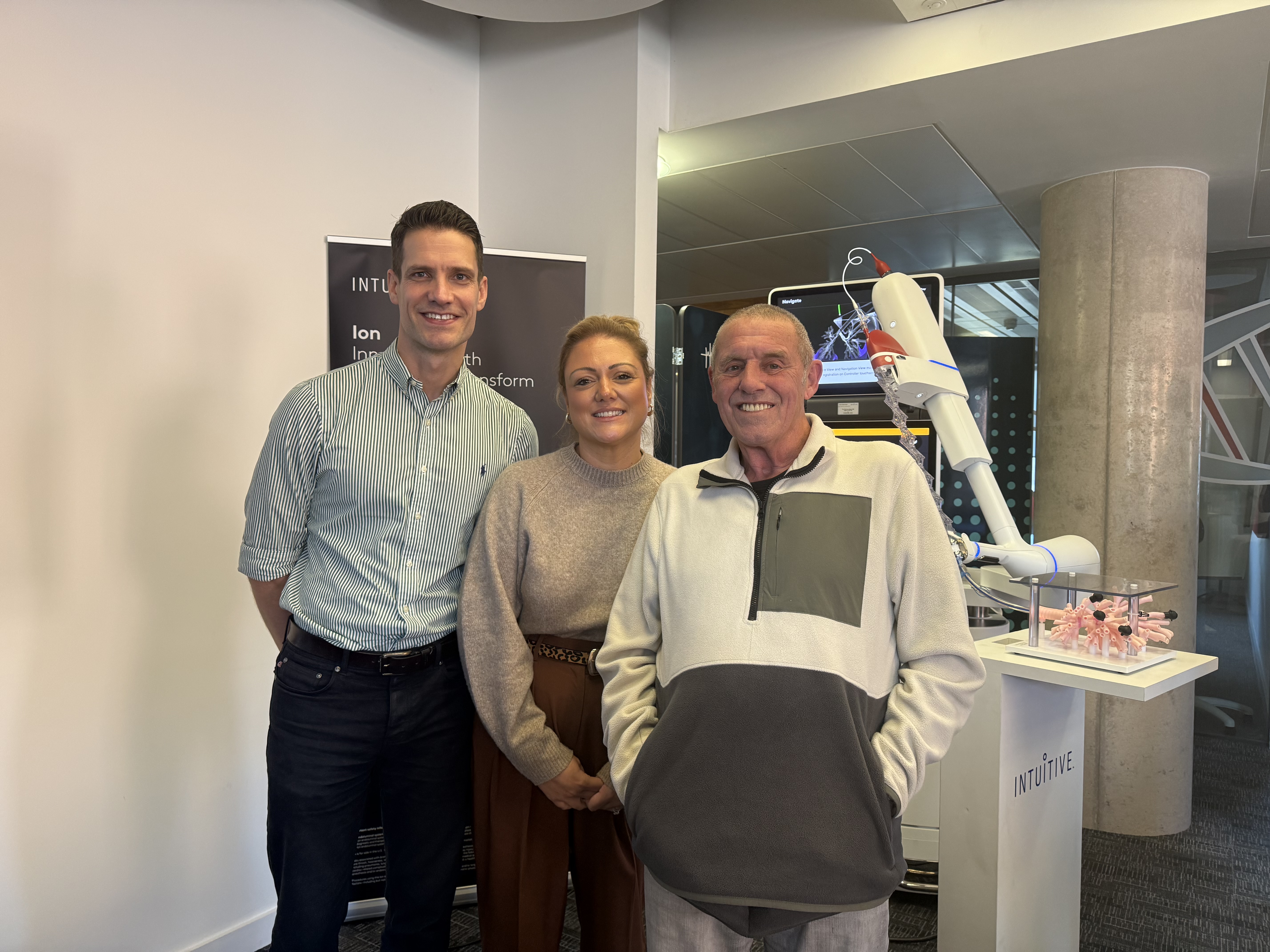
Brian recalls “The trauma consultant came round with some bad news. You’ve got cancer…it’s everywhere. Lungs, kidneys, bladder, prostate.”
Challenges to diagnosis
The shock was overwhelming, not just for Brian but for his family. Yet through uncertainty, Brain found hope in the treatment that followed. His journey to diagnosis was far from straightforward, with initial attempts to biopsy the tumours at Llandough Hospital were unsuccessful.
“They tried to take biopsies from my lungs, and the consultant said he was unable to, due to the position of the nodules, so they were struggling to get any type of biopsy from the lungs.”
It was then, that Brian was offered to travel to St Bartholomew Hospital, in London for a navigational bronchoscopy, a procedure not available locally. Navigational bronchoscopy by Intuitive, is a minimally invasive peripheral lung biopsy, that collects lung tissue samples, even when lung nodules are small and located in the periphery, allowing clinicians to reach small lesions of the lung with precision, and stability.
Craig Dyer, Respiratory Consultant, University Hospital of Wales, Wales Cancer Site Group (CSG) lead, explains the diagnosis journey to treatment for a navigational bronchoscopy for Brian and other eligible patients. Currently patients in Wales meet a local lung physician and undergo a series of scans (CT and PET), and lung function tests. This helps the team to highlight if early-stage cancer is present, and whether a standard CT-guided lung biopsy is possible. In Brian’s case, where he was unable to have a biopsy, the team discussed the option of a navigational bronchoscopy in London.
For this to happen, an individual patient funding request is sent to the panel within the health board, and once accepted the patient is then referred up to London. There are only a handful of centres in the UK that offer this advanced procedure, five of them based in London, with none in Wales – meaning patients often have to travel to London.
Brian’s journey and treatment in London
Brian’s wife and daughter were anxious, especially given the number of procedures Brian had already endured, unrelated to his lung cancer diagnosis. London was his seventeenth procedure overall. The repeated hospital visits and treatments had taken a toll on the whole family, making the journey to London particularly overwhelming.
“The trip to London was daunting. It [the procedure] should’ve been available here really, it’s a long journey. My wife and youngest daughter came with me; it cost £1,400 for two nights there. My family were worried, as I’d had lots of procedures in Cardiff, but they were more concerned and didn’t want me to be in London completely alone, in case something happened. Something like this can be a financial burden for people. To have this type of procedure here in Wales, would be much more convenient.”
Craig Dyer, Respiratory Consultant, University Hospital of Wales, Wales CSG lead, said:
“Once we’ve referred to St Bartholomew's Hospital, the patient is invited to London, within a few weeks, where the procedure is usually done on the same day of arrival, under general anaesthetic. The technology is programmed to know exactly where they need to take the biopsy from, so it’s a really specific, targeted biopsy.
The procedure itself takes around 40 minutes, and most patients can go home the same day, some stay overnight. Results are sent back to the team in Wales within a few weeks.”
The procedure itself was a turning point for Brian and family. “The procedure was brilliant. I was in, out. I could’ve come home the same day but stayed an extra night. After the biopsy in London, surgery was done within a month, locally. I have nothing but praise – I’m still here.”
“I’ve got to be honest; St Barts were brilliant. They really looked after me, I have nothing but praise, and even back down to the team in Cardiff. I think it’s absolutely essential that they have one of these [navigational bronchoscopy treatment] in Wales.”
Life after diagnosis and treatment
“Spending time with my family and granddaughter has become even more precious. I’m getting emotional that I even managed to walk my daughter down the aisle last year, which wasn’t expected.”
Life after diagnosis and treatment has changed for Brian. He’s had to retire but has found purpose volunteering at Velindre two days a week, giving back to the hospital that cared for him.
“The operation in the summer of 2024 has saved my life. The consultant had said to me that my cancer was aggressive. It hasn’t recurred [2025]. Every three months I have a phone appointment, and then in another year’s time, another scan to make sure it’s still clear.”
Brian was one of the first patients in Cardiff to travel to London for a navigational bronchoscopy – a procedure that saved his life. “With this surgery and normal life, I’m okay. Sometimes tired, or breathless, but I think it’s brilliant, and I’ve got no lung cancer!”
Integrating navigational bronchoscopy into the lung cancer pathway in Wales
Brian’s story highlights why introducing navigational bronchoscopy to Wales is a significant step in diagnosis, wellbeing, and patient experience. Making this technology available locally could transform the lung cancer pathway.
Currently, around a third of patients who undergo surgery for suspected early-stage cancer are later found to not have cancer. By enabling more accurate, minimally invasive biopsies, navigational bronchoscopy could help avoid unnecessary operations and ensure patients receive a faster, clearer diagnosis.
Craig Dyer, Respiratory Consultant, University Hospital of Wales, Wales CSG lead explains:
“Earlier and more accurate diagnosis, and earlier intervention are key. Having this service locally would mean less uncertainty and stress for patients and families, and would reduce the psychological, physical, and financial impact of diagnosis and treatment.”
This technology marks the beginning of a transformative journey for lung cancer diagnostics in Wales. The next step is to run an evaluated pilot in the south-east region, led by Craig and the clinical team, with the ambition to expand this approach across Wales. The pilot will assess the impact on patient outcomes and experience and lay the groundwork for making this advanced technology accessible to all who need it.
To find out more, contact hello@lshubwales.com.