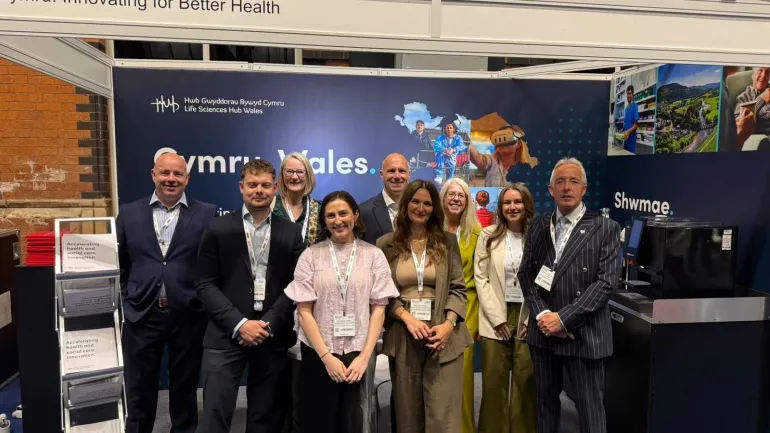
What if Wales could show what a truly innovation-led health system looks like? At the Welsh NHS Confederation conference, our session looked ahead to health and care in 2035 – imagining a system where prevention happens earlier, technology gives clinicians time back and more care happens closer to home.
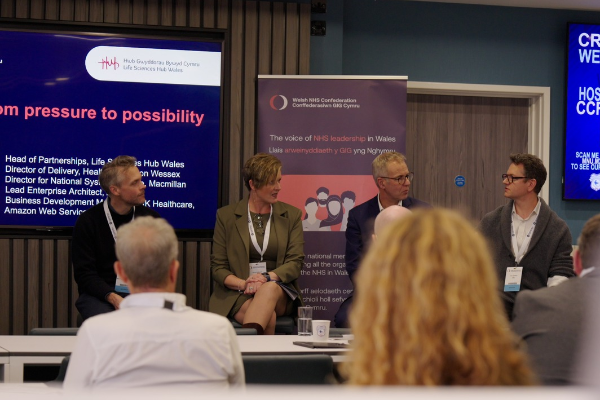

The discussion explored what needs to change now to turn that possibility into progress. It was a theme echoed across the conference; how do we move beyond responding to immediate pressures and create a health system capable of adopting innovation as part of everyday care?
What if? From pressure to possibility
Rising demand, workforce pressures, ageing and changing population needs, and persistent inequalities are well understood pressures. But one thing that’s increasingly clear: doing more of the same will not deliver different outcomes.
This builds on the conversation we’ve been developing through our recent thought leadership piece with Nation.Cymru and MHRA, exploring why capacity alone cannot resolve these pressures, and what it takes to make innovation part of everyday care.
What should an innovation-led NHS actually feel like for a patient?
An innovation-led NHS shouldn’t ultimately be judged by how much technology it has, but by whether people experience better care as a result.
For a patient, that could mean receiving diagnosis sooner, accessing more care within their community and spending less time travelling to hospital. It could mean their information moving with them when their care moves between services, rather than having to repeatedly explain their story or chase what happens next.
One perspective shared during the session shows why this matters. After being diagnosed with cancer, one contributor described becoming a “pushy patient” to secure the care and attention needed. Moving between different parts of the health system also meant encountering situations where results couldn’t be accessed by the next service, and information was not moving seamlessly alongside care.
A system designed around people should not require patients to become experts in navigating it.
For clinicians, it would mean having more time to be clinicians. Our discussion highlighted the amount of clinical time and energy spent transferring information between the systems, chasing updates, and manually managing handovers between services. Innovation should remove that friction, rather than add another layer to it.
What does this look like in practice?
Our recent Sector Intelligence reports show how care is already beginning to move beyond traditional settings.
Earlier diagnosis provides a glimpse of what working differently might look like. In west Wales, the PROSTAD pathway developed through Hywel Dda University Health Board, Cancer Research UK and the TriTech Institute redesigned the prostate cancer diagnostic pathway. It reduced the time between GP referral and MRI from 22 days to 14 days, cut MRI reporting time from eight days to one, and enabled patients to receive clinical review and biopsy decisions one day after MRI.
These are examples of what is possible now. Which leads to the harder question – when something works, how do we make it the standard part of practice across Wales?
Moving beyond ‘pilotitis’
The challenge of moving from promising pilots to widespread adoption was one of the strongest themes to emerge from our session and across the conference. The health and life sciences sector isn’t short of great ideas. The challenge is creating clearer pathways for those that demonstrate value to become part of everyday care.
The PROSTAD pathway highlighted earlier illustrates this challenge. Despite its positive results, our Sector Intelligence report suggests it has not yet been adopted by other Welsh health boards, although elements of the approach are reflected within the Welsh national optimal pathway.
By contrast, an AI-assisted digital pathology tool developed by Ibex Medical Analytics was piloted in Wales, detecting 13% more prostate cancers. The technology was rolled out across Wales.
What can we learn from these different experiences? What enables some innovations to move from testing to wider adoption while others remain within their original setting?
Successful adoption requires more than evidence that an innovation works. It means thinking about how promising approaches can be adopted more widely from the outset and creating the right conditions for that to happen through leadership, collaboration, shared priorities and clear pathways to implementation.
Who has to make this happen, and what needs to happen now?
One phrase that came through strongly in the discussion: “Wales has an opportunity to do things once, for Wales.” But being small and connected is only an advantage if we behave as one connected system.
Seven health boards serve different populations and local needs, and person-centred care must reflect those differences. But local delivery shouldn’t mean solving the same underlying problems seven times.
That means creating clearer routes from evaluation to adoption, so learning in one organisation informs decisions elsewhere, backed by leadership, political will, funding and collaboration.
An important point raised was that an innovation-led NHS also cannot depend on every busy clinician becoming an innovator. Instead, the system needs to make it easier for clinicians to deliver excellent care, removing unnecessary administrative burdens and ensuring that effective tools, information and pathways become part of everyday practice.
From possibility to progress
As Jacqueline Totterdell, Chief Executive, NHS Wales and Director General for Health, Social Care and Early Years within Welsh Government, reflected at the conference – “too often we still operate as individual organisations rather than as one system. And while there’s no shortage of activity, activity is not the same as progress if patients and the public do not feel and see the difference.”
Wales has an opportunity to make innovation part of everyday care. As a national integrator, Life Sciences Hub Wales has an important role in bringing together expertise, evidence and partners across health, academia and industry, creating the right conditions for innovation to thrive and be adopted at scale.
Many of the ingredients of that future already exist in Wales. The opportunity now is to bring them together with greater purpose, creating a health system where innovation is not the exception but part of everyday care.
That's how we turn possibility into progress that people can actually feel.
If you’d like to find out more about this session, get involved in future panel discussions, or explore the work of our Sector Intelligence team, please get in touch here.
A huge thank you to our panel for sharing their perspectives, experiences and ideas on what an innovation-led health and care system could look like for Wales.
- Dr Frank Ratcliff, Director of Delivery, Health Innovation Wessex
- Steve Haines, Director for National System Change, Macmillan Cancer Support
- Vicky Rothwell, Strategy and Transformation Enterprise Architect, Aire Logic
- Tom Griffiths, Business Development Manager – UK Healthcare, Amazon Web Services
- Richard Pugh, Head of Partnerships, Life Sciences Hub Wales